Most homeowners never think about roofing underlayment until something goes wrong. It’s hidden under the shingles, invisible from the street, and rarely comes up until an inspector or evaluator points it out during a report.
But along the Gulf Coast, underlayment is one of the first things we look at. Whether we’re conducting a standard home inspection in Fairhope, completing a FORTIFIED evaluation in Pensacola, or helping a homeowner in Biloxi understand why their roof didn’t hold up after a storm, underlayment is almost always part of the conversation.
Here’s what it is, why it shows up so often in inspection findings, and what the right product and installation actually look like in a region where storms are a fact of life.
Why Underlayment Comes Up in Inspections
During a home inspection, the roof is one of the most important systems we assess. From the exterior and the attic, we look for signs of improper installation, water intrusion, and material failure. Underlayment is often where problems start, and where they could have been prevented.
During a FORTIFIED evaluation, underlayment isn’t just noted. It’s verified step by step against specific IBHS standards, with photo documentation required at each stage. A roof that looks fine from the street can still fail a FORTIFIED evaluation if the underlayment wasn’t installed correctly underneath.
That’s why understanding what underlayment is, and what separates a good install from a poor one, matters for any homeowner buying, selling, or upgrading a home along the Gulf Coast.
What Roofing Underlayment Actually Is
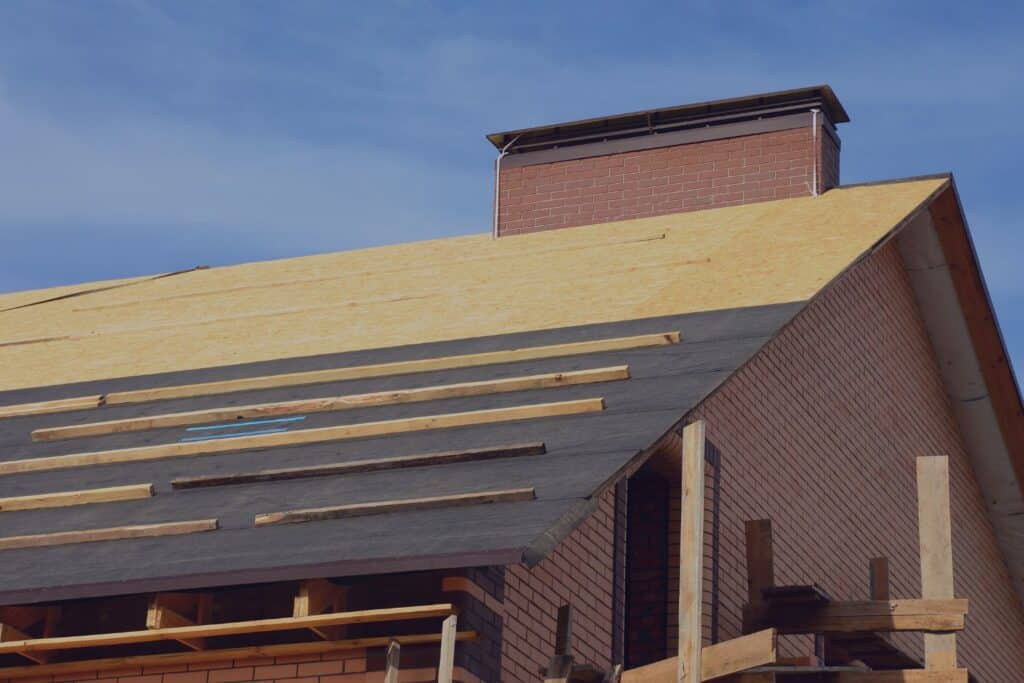
Underlayment is a water-resistant or waterproof layer installed directly on top of the roof deck, underneath the shingles, metal panels, or tile.
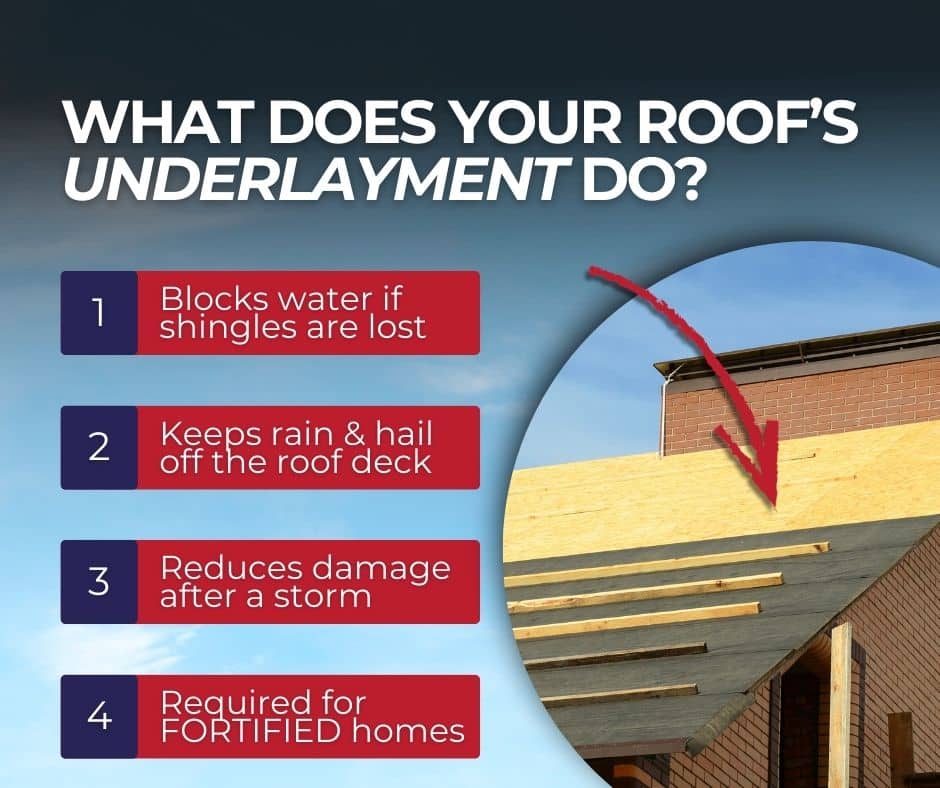
Its job is to act as a backup barrier. If the outer roofing layer is damaged or torn off in a storm, underlayment is what keeps water out of the home until repairs can be made.
Think of it like wearing a rain jacket under a windbreaker. The outer layer handles the brunt of the weather, but if it fails, the inner layer is what keeps you dry.
Every residential roof has some form of underlayment. The question is whether it’s the right type for the climate, the roofing material, and the level of storm protection the home requires.
Three Common Types of Roofing Underlayment
There are three common types of underlayment, and each one performs differently when the weather turns severe.
Asphalt-Saturated Felt
Sometimes called tar paper or roofing felt, this is the traditional option. It comes in two weights: 15-pound and 30-pound, with 30-pound being thicker and more durable. Felt has been used on roofs for decades, but it does not meet FORTIFIED standards in most Gulf Coast wind exposure categories, where synthetic is the minimum the standard accepts.
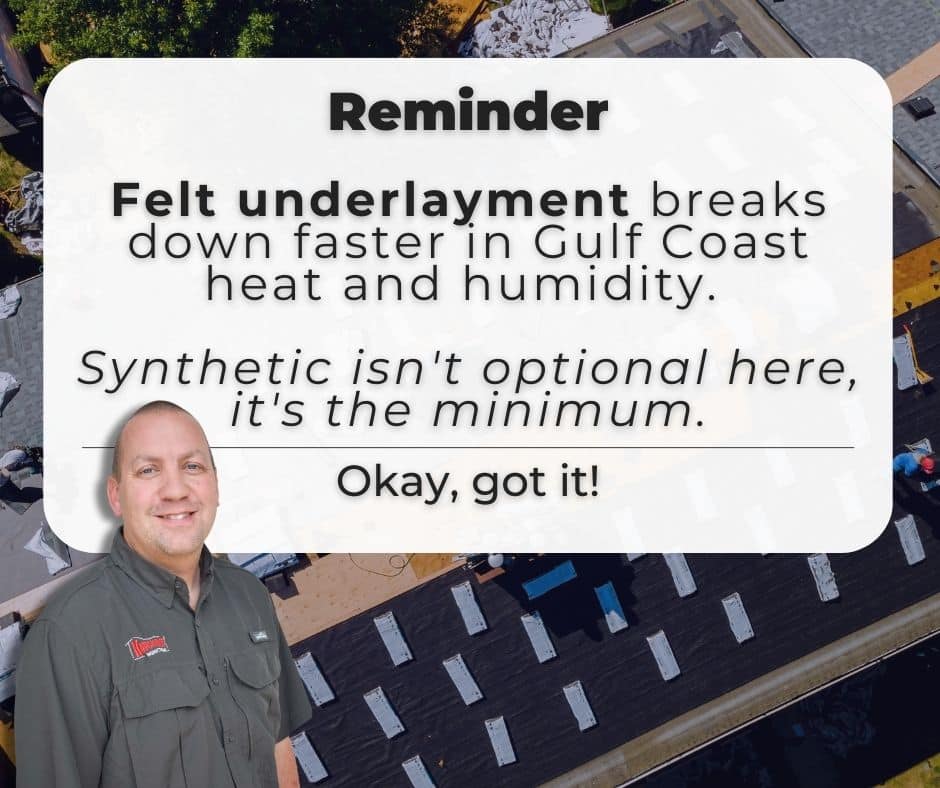
The problem along the Gulf Coast is that felt absorbs moisture. It wrinkles when wet, breaks down faster under heat and UV exposure, and loses performance quickly if it’s left exposed while waiting for the final roofing install. In a region where humidity never really goes away, that’s a meaningful drawback.
Synthetic Underlayment
Synthetic underlayment is made from woven or spun polypropylene. It’s lighter than felt, more tear-resistant, and doesn’t absorb moisture. It also holds up better if installation is delayed, which matters during busy storm-season re-roofing schedules across the Panhandle and coastal Alabama.
For most Gulf Coast homes, synthetic is the minimum worth considering. It handles heat, humidity, and high winds better than felt in almost every category.
Self-Adhered Membranes
Self-adhered membranes, sometimes called peel-and-stick, bond directly to the roof deck without fasteners. They create a watertight seal that synthetic and felt underlayment can’t fully replicate on their own.
These are commonly used in valleys, around chimneys and skylights, and along eaves where wind-driven rain tends to push water sideways under the roofing surface. In high-wind zones, they’re typically required in combination with a standard underlayment layer, and they’re a core requirement for FORTIFIED Roof certification.
How the Three Types Compare
| Type | Moisture Resistance | Durability | Best For |
| Asphalt Felt (30#) | Low to moderate | Short to medium term | Meeting basic code minimums |
| Synthetic | High | Long term | Most Gulf Coast re-roofing projects |
| Self-Adhered Membrane | Highest | Long term | Valleys, eaves, and FORTIFIED installs |
What Do FORTIFIED Certifications Require?
FORTIFIED is a storm-resistance standard developed by the Insurance Institute for Business and Home Safety (IBHS). For homeowners along the Gulf Coast, it’s also the path to real insurance discounts and, in several states, grants that help pay for roof upgrades.
The underlayment requirements for FORTIFIED Roof certification go well beyond standard building code. Here’s what the standard calls for:
- Self-adhering tape is applied over all roof deck seams before any underlayment is laid
- 30-pound felt or equivalent synthetic underlayment installed over the sealed deck
- Ring-shank or deformed-shank fasteners with a minimum 1-inch cap, spaced 6 inches on center along all laps and 12 inches on center in the field
- Minimum 4-inch horizontal laps and 6-inch end laps throughout the entire install
The reason the deck seal matters so much: IBHS testing shows a properly sealed deck can reduce water entry by up to 95% even when shingles are completely gone. That’s the difference between a manageable repair and a gutted interior after a major storm.
This is exactly why a certified FORTIFIED Evaluator needs to be involved before and during the roofing project, not after it’s finished. Once the shingles are on, the underlayment and deck work underneath can no longer be photographed or verified. Without that documentation, certification won’t be issued, no matter how well the work was done.
How Underlayment Requirements Differ Across the Gulf Coast
Building code sets a floor, not a ceiling. Where your home sits on the map changes both what’s required and what’s actually recommended for meaningful storm protection.
- Florida Panhandle (Pensacola, Crestview, Destin): Synthetic or 30-pound felt required by code. FORTIFIED adds a self-adhered tape seal on deck seams before the underlayment layer.
- Alabama Gulf Coast (Fairhope, Gulf Shores, Mobile): 30-pound felt minimum by code. FORTIFIED requires the sealed deck system plus ring-shank fasteners throughout.
- Mississippi Gulf Coast (Biloxi, Gulfport, Hattiesburg): Same minimums as Alabama. FORTIFIED adds required photo documentation at each stage of installation.
- Louisiana (New Orleans, Slidell): Synthetic is widely recommended. FORTIFIED fastener spacing is more strict in the highest wind zones.
The gap between code minimum and the FORTIFIED standard is real. That gap is where storm damage tends to happen.
What the Evaluation Process Actually Looks Like
When Knockout conducts a FORTIFIED evaluation, underlayment isn’t something we assess after the fact. The evaluator needs to be present and documenting during the installation process, because once the roof is finished, critical details are no longer visible.
During evaluation, we verify and document:
- Whether the deck seams were sealed with self-adhering tape before the underlayment went down
- Fastener type and spacing across the field and at all laps
- Overlap dimensions at horizontal and end laps
- Drip edge placement relative to the underlayment at eaves and rakes
- Photo records confirming each step meet current IBHS standards
For standard home inspections, underlayment isn’t always directly visible. But signs like buckling, staining at the deck, improper drip edge placement, or attic evidence of past water intrusion can all point to underlayment problems worth flagging.
For buyers purchasing a home with an existing FORTIFIED designation, it’s worth verifying the certification hasn’t lapsed. Certifications are valid for five years and require a renewal evaluation to stay active. Knockout can check the status of any property’s FORTIFIED certificate by address.
Underlayment as Part of a Bigger System
Underlayment doesn’t work in isolation. It’s one layer inside a roofing system that also includes the deck attachment, fasteners, drip edge, flashing around penetrations, and the outer roofing material. A weak link anywhere in that chain can undermine everything else.
This is the core idea behind FORTIFIED: the roof is a system, not just a surface. A properly installed synthetic underlayment with the correct fastener schedule does more for real storm performance than expensive shingles installed over a loose, poorly attached deck.
Getting the evaluator involved early, before a roofer starts tearing off the old material, is what makes the difference between a roof that qualifies for certification and one that doesn’t, even if the materials and labor are otherwise identical.
Related Questions
What happens during a FORTIFIED Roof evaluation?
A certified FORTIFIED Evaluator inspects and documents the roofing system against IBHS standards at key stages of installation. This includes verifying deck attachment, underlayment, fasteners, drip edge, and flashing. The evaluator submits the documentation to IBHS, which then issues the designation certificate.
How often does a FORTIFIED certification need to be renewed?
Every five years. A renewal evaluation confirms the roof still meets current IBHS standards and that no storm damage or repair work has affected its certification status. Letting a designation lapse can impact insurance discounts and resale value.
Do Gulf Coast states offer grants to help pay for FORTIFIED roof upgrades?
Several do. Alabama, Mississippi, and Louisiana each have active programs that cover up to $10,000 toward qualifying roof upgrades. All of them require a certified FORTIFIED Evaluator to be involved before and after the work is completed.
Can a home qualify for FORTIFIED certification during new construction?
Yes. Builders can follow FORTIFIED standards during construction and document each step as the work progresses. Getting an evaluator involved at the start of the project is the most efficient path to certification for new builds.
When to Call a Professional
If you’re a homeowner planning a re-roofing project and want FORTIFIED certification, the first call should be to a certified FORTIFIED Evaluator, not just a roofer. The evaluator sets the documentation requirements, confirms the right underlayment spec for your home and location, and stays involved through the process so the finished roof can actually be certified.
If you’re buying a home with an existing FORTIFIED designation, have the certification status verified and a current inspection completed before closing.
A lapsed or improperly documented designation doesn’t carry the same insurance or resale value as one that’s active and current.
Conclusion
Underlayment won’t come up in a listing description or a neighborhood comparison. But in a region where Gulf Coast storms can strip a roof bare in minutes, it’s one of the most important layers in the whole system.
Knockout Inspections works with homeowners, buyers, sellers, roofers, and builders across Alabama, Florida, Mississippi, Louisiana, and beyond. Whether you need a home inspection, a FORTIFIED evaluation, or a certification renewal, the Knockout team is here to help. Get in touch with our team today.