
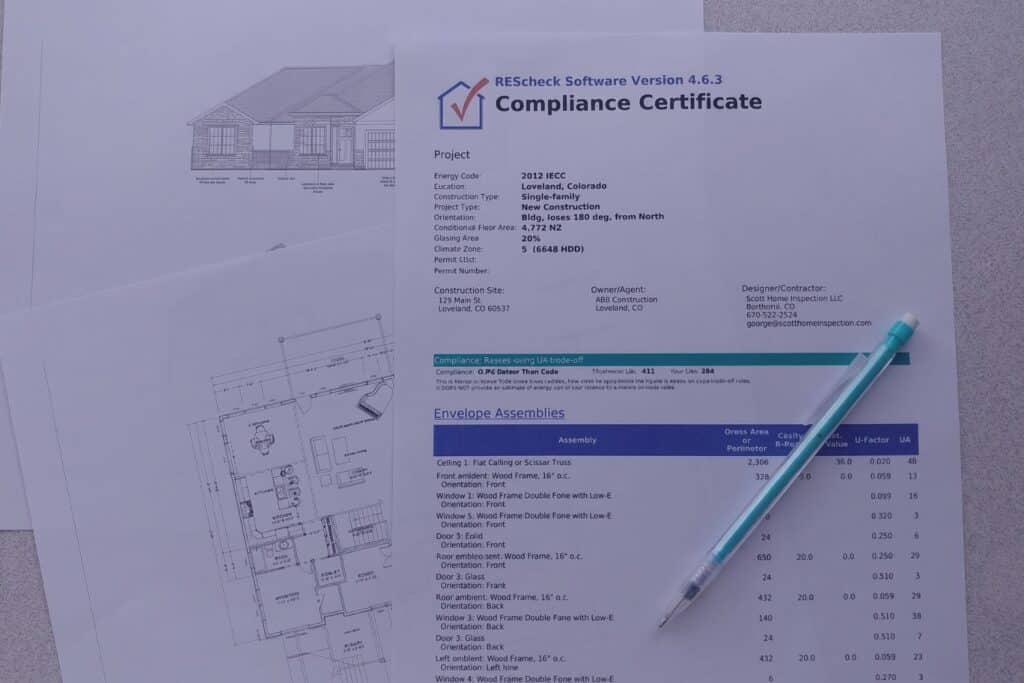
A REScheck report is the document that proves a home’s design meets the energy code, and most building departments require it before they will issue a permit. It is generated by free software from the U.S. Department of Energy, which checks a project’s insulation, windows, doors, and heating and cooling against the energy code for your area and reports a simple pass or fail.
If you’re having a new home built, putting on an addition, or doing a major renovation, you will almost certainly need one. This guide covers what the report contains, when it is required, who prepares it, and how to get one without stalling your permit.
What Is a REScheck Report?
REScheck is a free software application from the U.S. Department of Energy used to show that a residential building meets energy code. You enter the project’s details, and the software checks them against the residential energy requirements in the applicable code, usually a version of the International Energy Conservation Code (IECC) or a state-specific standard, then produces a compliance report for the building department.
In plain terms: the REScheck report is the paperwork that tells a code official your home is built to be energy efficient enough to pass. It applies to residential projects such as single-family homes and low-rise multifamily buildings. The commercial equivalent is a different tool called COMcheck, which we cover further down.

What’s Included in a REScheck Report?
A complete REScheck report is more than a single page. It generally contains three parts:
- Compliance certificate: the summary page listing the project name, location, energy code version, construction type, project type (new construction, addition, or alteration), and the pass or fail result.
- Inspection checklist: the items a code official or inspector confirms in the field against what was entered, so the finished home actually matches the paperwork.
- Detailed compliance results: the assembly-by-assembly breakdown showing how each part of the home performs against code.
The report is built from the details of your home’s “thermal envelope,” which is everything that separates the heated and cooled inside from the outdoors: your building dimensions, the insulation in the walls, ceilings, and floors, the windows and doors, and the efficiency of your heating and cooling system.
A few of those details show up as ratings that are worth understanding, since they are what the report is really judging:
- R-value: how well insulation resists heat flow. A higher R-value means better insulation.
- U-factor: how much heat a window or door lets pass through. A lower U-factor means less heat lost.
- SHGC (Solar Heat Gain Coefficient): how much of the sun’s heat a window lets in. A lower SHGC keeps more summer heat out.
The software totals all of this up and compares it to the code for your area. If your design meets or beats the requirement, the certificate reads as compliant and often notes how much better than code the home performs. If it falls short, the report points to exactly which assemblies need improvement, which we cover next.
When Do You Need a REScheck report?
You typically need a REScheck report any time you are adding conditioned (heated or cooled) residential space and pulling a permit. The most common triggers are:
- New home construction: almost always required as part of the permit package.
- Additions: REScheck evaluates the new portion the same way it evaluates new construction, so only the added area needs to be entered.
- Major renovations or alterations: when you change the thermal envelope, such as new walls, windows, or insulation.
Requirements are enforced at the state and local level, so the exact code version and submission process depend on your jurisdiction. In Kentucky, for example, a report is commonly required during permitting for new homes, additions, and major renovations.
Who Needs a REScheck report (and Who Prepares It)?
REScheck reports are used by the people responsible for getting a project permitted and approved:
- Builders and general contractors
- Architects, designers, and engineers
- Homeowners acting as their own contractor on a build or addition
The report is prepared by whoever handles the project’s energy compliance, then submitted to the local code enforcement office as part of the building permit application. Because getting the inputs right takes familiarity with the software and the current code, many builders and homeowners hand it to a certified provider rather than risk a rejected permit.
If you are already lining up other permit documents, it pairs naturally with services like a Manual J load calculation and, where required, a blower door test to confirm air tightness.
If you are also weighing what to check on a brand-new home beyond the paperwork, this checklist for buying a new build is a useful companion read.
What Happens If Your Project Fails REScheck?
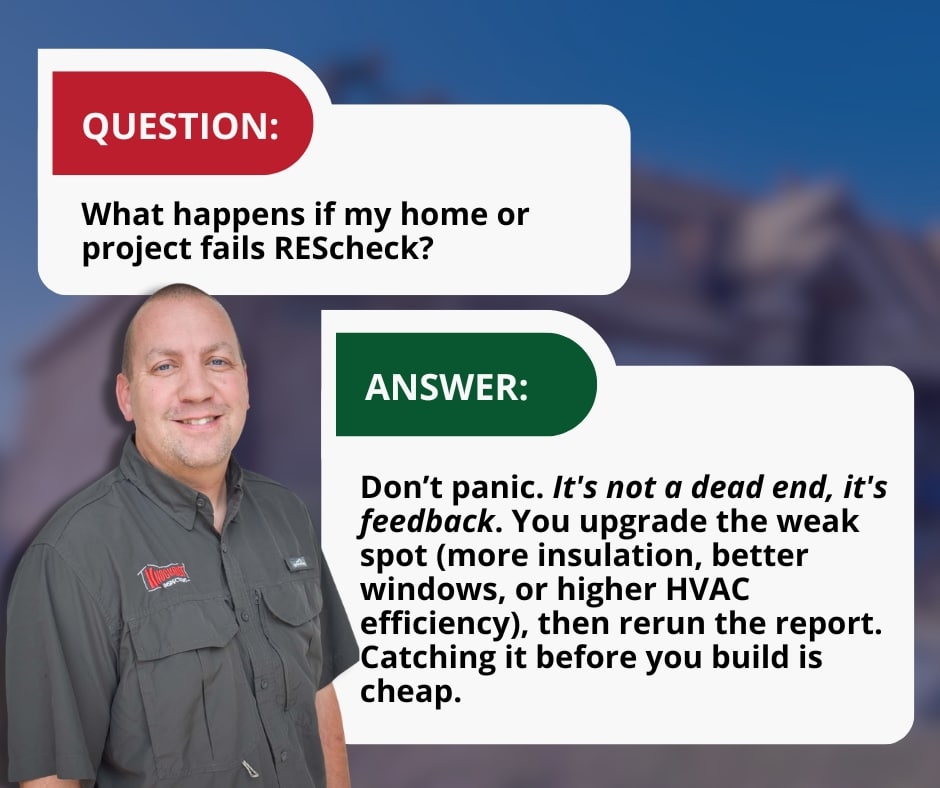
A “failing” result is not the end of the road; it is just feedback for you to act upon. When the report shows the design does not comply, you adjust the specifications and run it again. Common fixes include increasing insulation in walls, ceilings, or floors, upgrading to windows with better U-factors, or improving HVAC efficiency.
Once the revised numbers are entered and the software shows compliance, you generate a new report to submit. Catching this before construction is far cheaper than discovering it at a failed inspection.
REScheck vs. COMcheck
These two DOE tools are often mentioned together, but they cover different buildings:
| Consideration | REScheck | COMcheck |
|---|---|---|
| Building type | Residential (single-family, low-rise multifamily) | Commercial and high-rise residential |
| Demonstrates compliance with | IECC residential requirements | ASHRAE 90.1 / IECC commercial |
| Who uses it | Home builders, residential contractors | Commercial builders, designers |
If your project is commercial, you will be working with a COMcheck report instead. For what to expect from a commercial building evaluation more broadly, see this overview of a commercial inspection report.
How to Get a REScheck report
There are two paths. You can download the free software from the DOE, learn the interface and your local code version, enter every envelope detail accurately, and generate the report yourself. This works if you are comfortable with the tool and have time before your permit deadline.
Or you can hand it to a licensed provider. At Knockout Inspections, our REScheck services cover the whole process: we gather your project details, run the compliance evaluation, deliver a permit-ready report, and support any revisions the building department requests. That removes the guesswork and the risk of a rejected permit, which matters most when a deadline is close.
Related Questions to Explore
What is a REScheck report used for?
It documents that a residential project meets the energy code and is submitted to the building department as part of the permit application.
Is a REScheck report required by law?
Energy codes are adopted and enforced at the state and local level, so whether REScheck is required and which code version applies depends on your jurisdiction. Most areas require some form of energy compliance documentation for new residential construction and additions.
Who can prepare a REScheck report?
Builders, designers, engineers, homeowners, or a certified third-party provider. There is no single required credential, but accuracy matters because errors can produce a false compliance result.
Do I need a new REScheck for a remodel?
If the remodel changes the thermal envelope (walls, windows, insulation) or adds conditioned space, yes. Cosmetic remodels that do not touch the envelope usually do not.
When to Call a Professional
Consider handing your REScheck report to a certified provider when:
- Your permit deadline is close, and you cannot risk a rejection
- The project is a multifamily build or otherwise complex
- You are unsure which code version your jurisdiction has adopted
- Your initial results are failing, and you are not sure how to fix them
- You would rather focus on building than on software inputs
A provider who prepares these reports regularly knows the current code, enters the envelope correctly the first time, and delivers a document the building department will accept.
Conclusion
A REScheck report is a small but essential piece of getting a home permitted: proof that the design meets the energy code. If you are planning a new build, an addition, or a major renovation and want the report handled right the first time, Knockout Inspections can prepare it for you.
Schedule your REScheck visit and keep your project moving.