
A FORTIFIED Evaluator is a credentialed third party who verifies and documents that a home meets the IBHS FORTIFIED building standard so it can earn an official designation. That is a different job from a home inspector, who checks a home’s overall condition for a buyer or seller.
At Knockout Inspections, we do both, so we field this question constantly. This guide explains what a FORTIFIED Evaluator actually does, how the role compares to a home inspector, and when you need each one.
What Is a FORTIFIED Evaluator?
A FORTIFIED Evaluator is an independent professional trained to confirm that a home is built or retrofitted to FORTIFIED, a voluntary construction standard created by the Insurance Institute for Business & Home Safety (IBHS) to help homes survive hurricanes, high winds, and severe storms.
The standard exists because most storm damage starts small, a few shingles lift, water gets in, and the loss cascades from there. FORTIFIED closes those weak points with tested, documented upgrades. But a home does not earn a designation just because the work was done. Someone independent has to verify it, and that someone is the evaluator.
Evaluators are credentialed through the FORTIFIED program, administered by IBHS with Smart Home America, and they work independently from the contractor doing the work. That separation matters: the contractor is paid to build, while the evaluator is there to confirm the build actually meets the standard. Their sign-off is what lets a home receive an official designation, which in many states can also qualify the homeowner for insurance premium discounts. You can see where the role fits on our FORTIFIED options for homeowners page.
What Does a FORTIFIED Evaluator Actually Do?
A FORTIFIED Evaluator verifies that each required upgrade is installed correctly, documents the proof, and submits it to IBHS so your home can earn its designation. The work happens in stages, because the most important details get hidden once the next layer goes on.
On a re-roof, for example, the evaluator typically:
- Inspects the bare roof deck and confirms it is fastened with the right nails at the right spacing
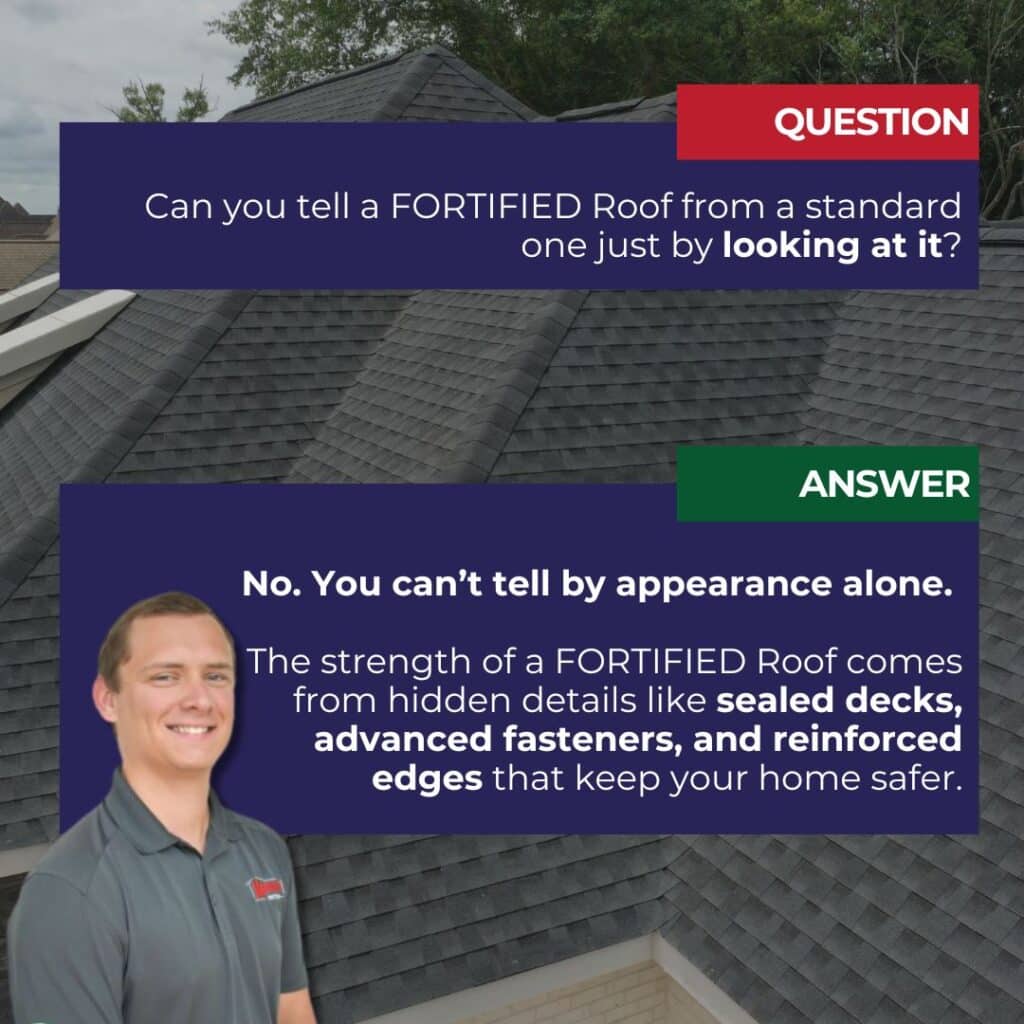
- Verifies the sealed roof deck, the secondary water barrier that keeps water out if shingles blow off
- Checks edge details like drip edge and starter strips that stop wind from peeling the roof back
- Confirms the roof covering is rated for the wind speeds your area requires
- Documents each step with photos and paperwork and submits the package to IBHS
On a new build, the evaluator works alongside your contractor from the start, confirming the right materials and connections at each phase before they are covered up. Whether it is a FORTIFIED Roof or a full FORTIFIED Gold home, certain details have to be documented at the moment they are visible, not after drywall and siding hide them.
The evaluator does not do the construction and has no stake in cutting corners. That independence is the whole point. They also handle renewals and re-designations when a certificate comes due, since most designations have to be renewed to stay active. When you are ready to pick one, here is how to hire a FORTIFIED Evaluator.
The Three FORTIFIED Designations
The evaluator certifies a home to one of three levels, and each builds on the one before it. The level you choose shapes what gets inspected and documented.
- FORTIFIED Roof: the entry level and the most common. The evaluator focuses on roof deck attachment, the sealed roof deck, the edges, and a wind-rated roof covering. This is the first line of defense and the one most state grant programs fund.
- FORTIFIED Silver: includes everything in Roof, then adds protection for openings. The evaluator verifies rated windows, doors, and garage doors, plus gable-end bracing and anchored attachments like porches and carports.
- FORTIFIED Gold: includes Roof and Silver, then adds a continuous load path that ties the roof to the walls and the walls to the foundation, so wind forces transfer safely into the ground instead of pulling the home apart.
A home has to earn the lower levels before it can reach the next, so an evaluator often guides homeowners through them in order.
FORTIFIED Evaluator vs. Home Inspector: What’s the Difference?
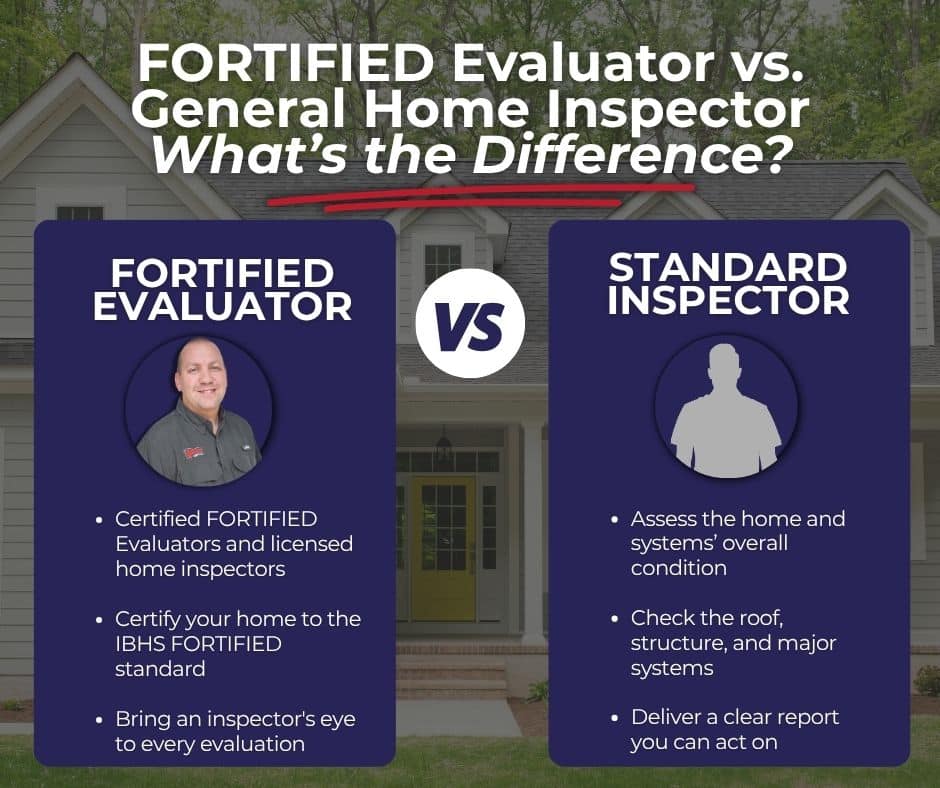
A home inspector assesses the overall condition of a home at a moment in time, usually for a sale. A FORTIFIED Evaluator verifies that specific construction meets the FORTIFIED standard so the home can be certified. Different purpose, different timing, different result.
| Consideration | FORTIFIED Evaluator | Home Inspector |
|---|---|---|
| Main purpose | Certify the home to the IBHS FORTIFIED standard | Assess overall condition and safety |
| What they check | The specific FORTIFIED upgrades (roof deck, attachments, connections) | Roof, structure, plumbing, electrical, HVAC, and more |
| Timing | During a build or re-roof, at set stages | Usually, once, during a real estate transaction |
| Result | An official designation: Roof, Silver, or Gold | A condition report on defects, not pass or fail |
| Standard used | IBHS FORTIFIED construction standard | State, InterNACHI, or ASHI standards of practice |
Put simply, a home inspection tells you what shape a house is in. A FORTIFIED evaluation proves it was built to take a beating. A home inspector produces a report on the condition of the roof, structure, plumbing, electrical, and other systems, and nothing passes or fails. A FORTIFIED Evaluator produces an official designation measured against one specific standard, and the home either meets it or it does not.
Here is where it gets practical. Say you are buying a coastal home. You would get a home inspection to understand its condition before you close, and you might separately want to know whether it carries a FORTIFIED designation, because that can affect your insurance. The two answer different questions, which is why many homeowners end up needing both.
Why It Helps When Your Evaluator Is Also a Home Inspector
When the same person holds both credentials, you get the FORTIFIED expertise to earn the designation plus the trained eye of an inspector who understands how the whole house behaves. A single-purpose evaluator confirms the FORTIFIED checklist and stops there.
An inspector who is also an evaluator notices the things outside that checklist, like aging flashing, poor attic ventilation, or a soft spot in the decking, that could undermine the roof you just paid to strengthen.
Knockout’s founder, Nathan Lippincott, is a Certified Master Inspector and a FORTIFIED Evaluator, and our team includes Gold FORTIFIED specialists. That dual background means we can verify FORTIFIED compliance and flag condition issues in the same visit. You can read more about our standards and credentials to see how we approach both roles.
Related Questions to Explore
Is a FORTIFIED Evaluator the same as a home inspector?
No. They can be the same person, but they have different jobs. An evaluator certifies a home to the FORTIFIED standard; a home inspector reports on a home’s overall condition.
Can any home inspector perform a FORTIFIED evaluation?
No. Only professionals who hold the FORTIFIED Evaluator credential through the program can certify a home. Many evaluators come from a home inspection or construction background, but the credential is separate and required.
Do I still need a home inspection if I get a FORTIFIED evaluation?
Usually yes. A FORTIFIED evaluation certifies the home to a wind standard. A home inspection tells a buyer the condition of the whole house. If you are buying, you generally still want both.
Does a FORTIFIED designation lower my insurance?
In many storm-prone states, it can. Insurers and state programs often offer premium discounts or credits for FORTIFIED homes, since they are built to sustain less damage. The exact savings depend on your state and insurer, so confirm with your provider.
Who credentials of FORTIFIED Evaluators?
They are trained and credentialed through the FORTIFIED program (IBHS, with Smart Home America). You can find credentialed evaluators in the official IBHS evaluator directory.
Does a FORTIFIED Evaluator inspect the whole house?
No. The evaluation is scoped to the FORTIFIED standard, the roof, attachments, openings, and connections, depending on the level, not every system in the home.
How do I find a FORTIFIED Evaluator near me?
Search the IBHS evaluator directory, or contact a local provider like Knockout Inspections that serves your area and can walk you through the process.
When to Call a Professional
You need a FORTIFIED Evaluator when you are:
- Re-roofing and want a FORTIFIED Roof designation
- Building new to FORTIFIED Silver or Gold
- Renewing or redesignating an existing certificate
- Applying for a state grant like Strengthen Alabama Homes or Louisiana Fortify Homes, which requires a FORTIFIED evaluation
- Trying to qualify for a FORTIFIED insurance discount in your state
You need a home inspector when you are buying or selling and want a clear read on a home’s condition. The good news is you do not have to choose between two companies. Knockout does both across Alabama, Florida, Louisiana, Mississippi, and Kentucky, with FORTIFIED evaluations available nationwide.
Conclusion
The two roles are easy to mix up, but they do different work:
- A FORTIFIED Evaluator certifies a home to the IBHS standard; a home inspector assesses its condition
- They differ in purpose, timing, and result, and many homeowners need both
- Hiring a pro who is both gives you the certification and a complete read on the home
Starting the FORTIFIED process, or not sure which one you need? Talk to the team at Knockout Inspections, and we’ll point you in the right direction.