
Manual S is the ACCA standard used to select the right HVAC equipment for a home based on its actual heating and cooling needs. If your contractor ran a Manual J load calculation but stopped there, the equipment selection step is still missing.
At Knockout Inspections, we offer Manual S equipment selection as part of our EnergyWise services because the right equipment choice makes a real difference in comfort, efficiency, and long-term costs. This post explains what Manual S means, how it works alongside Manual J, and why it matters for your home.
Manual S In Simple Terms
Manual S stands for “Residential Equipment Selection.” The Air Conditioning Contractors of America (ACCA) developed it to tell contractors which HVAC equipment is actually suited to a home after the load calculation is done.
The S stands for selection. That single word matters a lot. This is not about calculating how much heating or cooling a home needs. That is Manual J’s job. Manual S takes those load results and uses manufacturer performance data to confirm that a specific piece of equipment can actually meet those needs under your home’s real conditions.
Per ACCA’s official Manual S standard, Manual S provides specific sizing requirements for 11 types of cooling and heating equipment and includes detailed guidance on how to interpret manufacturer performance data. It covers things like:
- Cooling capacity (sensible and latent)
- Heating capacity
- Efficiency ratings, including SEER and HSPF
- System compatibility with the duct design
Without this service, a contractor is making an educated guess about which unit to install. With it, the selection is tied directly to your home’s actual conditions.
How Manual S Works With Manual J
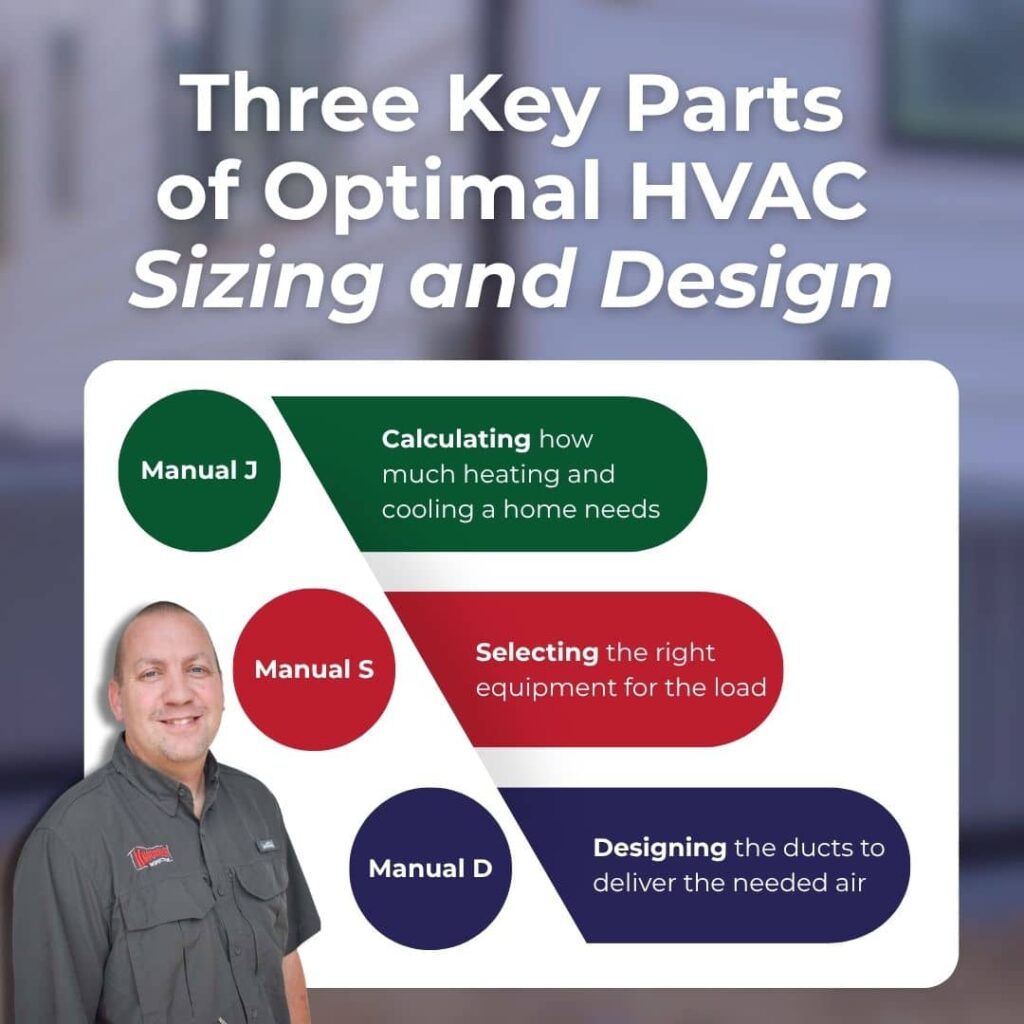
Manual J and Manual S work as a pair. Manual J calculates the load, and Manual S selects the equipment to meet that load. Skipping one makes the other incomplete.
Here is a simple way to think about it: Manual J tells you how much heating or cooling your home needs. Manual S confirms that the equipment you are about to install can actually deliver that amount under your specific conditions, not just under the standard test conditions used in the lab.
You can learn more about how Manual J load calculations affect your HVAC system on our blog, but the short version is that Manual J accounts for your home’s square footage, insulation, windows, climate, and other factors to find the right heating and cooling load.
Manual S then takes that number and cross-references it with OEM (original equipment manufacturer) data to confirm the selected unit’s real-world capacity. This matters because manufacturer ratings measure under standardized lab conditions, not the actual design conditions of your home.
Why Nominal Tonnage Is Not the Whole Story
Most homeowners hear something like “you need a 3-ton system” and assume that any 3-ton unit will do the job. That is not how it works.
A system labeled as 3 tons has a nominal capacity of 36,000 BTUs. How much cooling it actually delivers depends on the indoor temperature, the outdoor temperature, humidity levels, airflow, and how well the indoor and outdoor units are matched. Two 3-ton systems from different manufacturers can perform very differently under the same conditions.
Manual S is what turns the load calculation number into an actual equipment choice. It accounts for those real-world variables, so the system you get is not just the right size on paper but actually performs correctly in your home.
What Happens When You Skip Manual S?
Skipping Manual S is common. Many contractors size equipment by rule of thumb or by matching the old unit. The results tend to show up quickly.
- Oversized equipment: The most common outcome. An oversized system cools the air temperature fast, but does not run long enough to pull humidity out. You end up with a home that feels cool but damp. The system also short-cycles, meaning it turns on and off more frequently. That adds wear and tear, raises energy bills, and shortens the life of the unit.
- Undersized equipment: The opposite problem. The system runs constantly, trying to keep up but never quite gets there. Rooms stay warm in summer or cold in winter, and energy costs climb.
- Poor humidity control: In humid climates like the Gulf Coast states that Knockout serves, latent cooling matters as much as sensible cooling. A system selected without Manual S often underperforms on humidity removal, which affects air quality and comfort all summer long.
- Code issues: The International Residential Code references ACCA Manual S for equipment selection. In many areas, skipping this step puts the installation out of compliance, which can cause problems at inspection or when you go to sell the home.
Our Manual S equipment selection service to catch and prevent exactly these issues before they go into a new or replacement system.
Who Needs a Manual S Calculation?
Not every homeowner will run this calculation themselves, but it is worth knowing when one is required and who should be asking for it.
- New construction: If you are building a new home, your HVAC contractor should be completing Manual J and Manual S before any equipment is selected or ordered. Most building codes now require both.
- HVAC replacement: If you are replacing an existing system, a new Manual S is appropriate. Your home may have changed since the original system was installed. Insulation upgrades, window replacements, additions, and air sealing work all change the load. Using a new Manual S ensures the replacement equipment actually fits the home you have now, not the one you had 15 years ago.
- FORTIFIED home upgrades: This one surprises a lot of homeowners. When a home is upgraded to FORTIFIED standards, the building envelope changes significantly. A sealed roof deck, reinforced openings, and improved connections reduce air leakage and change how heat and moisture move through the home. That shift affects your HVAC load. An HVAC system sized before a FORTIFIED upgrade may no longer be the right fit after one. Running a new Manual S after major envelope work is a smart way to make sure the system still matches the home.
- Energy-efficiency programs: If your project involves ENERGY STAR certification or other efficiency programs, Manual S is often a required deliverable. The same applies to projects going through green building programs like the National Green Building Standard.
- Permit applications: Some jurisdictions require a Manual S report as part of the HVAC permit package. Check your local requirements before submitting.
You can also pair Manual S with Manual D duct design to make sure the ductwork can deliver the airflow the selected equipment needs. Equipment and ducts design around each other, and a mismatch between the two is one of the most common causes of comfort complaints.
Related Questions to Explore
Is Manual S a requirement of the building code? In many areas, yes. The International Residential Code references ACCA Manual S for residential equipment selection. Requirements vary by jurisdiction, so check with your local building department. Projects tied to ENERGY STAR, green building certifications, or permit-required HVAC replacements are most likely to require a formal Manual S report.
Can a contractor skip Manual S if they already did Manual J? Not accurately. Manual J gives you the load number, but it does not tell you whether a specific unit can actually meet that load under your home’s real conditions. Without Manual S, equipment selection relies on nominal tonnage alone, which often leads to oversizing. The two calculations are designed to go together.
What does Manual S actually check when selecting equipment? Manual S checks that the selected equipment can meet your home’s sensible cooling load, latent (humidity) cooling load, and heating load at the design conditions specific to your location. It uses the manufacturer’s actual performance data, not just the rated capacity on the label, to confirm that the unit will perform correctly in your home.
Does Manual S apply to heat pumps and mini-splits? Yes. Manual S covers 11 types of heating and cooling equipment, including heat pumps. The ACCA second edition added updated sizing rules for multi-speed and variable-speed equipment. Whether you are selecting a standard split system, a heat pump, or a ductless mini-split, the Manual S process applies.
When to Call a Professional
If you are building a new home, replacing an HVAC system, or applying for a permit that requires mechanical design documentation, a Manual S calculation is not a DIY project. It requires access to OEM performance data, knowledge of your local design conditions, and the ability to interpret the results alongside a Manual J load calculation.
The team at Knockout Inspections provides Manual S equipment selection for homeowners, contractors, and builders across Alabama, Florida, Louisiana, Mississippi, and Kentucky. We provide the documentation you need for permits, energy programs, and contractor coordination.
If your contractor is recommending a system but has not mentioned Manual S or Manual J, that is worth a conversation. Ask whether the equipment selection was based on a formal calculation or a rule of thumb. The answer tells you a lot about what you are getting.
Conclusion
Manual S is the step between knowing what your home needs and choosing equipment that can actually deliver it. Real manufacturer performance data confirms that the selected HVAC system will handle your home’s heating, cooling, and humidity loads under your actual conditions, not just on paper.
Key takeaways:
- Manual J calculates the load; Manual S selects the equipment to meet it
- Skipping Manual S leads to oversizing, poor humidity control, and code issues
- Homes that have gone through major upgrades, including FORTIFIED work, may need a new Manual S to make sure the equipment still fits
If you need a Manual S equipment selection for a new build, a replacement system, or a permit package, Knockout Inspections offers this service across our full service area. Schedule with our team today.