

No home is completely tornado-proof, but you can make almost any house far more tornado-resistant with the right upgrades. At Knockout Inspections, we evaluate homes against the FORTIFIED standard every day, and the pattern is clear: storm damage usually starts at the roof and spreads through weak points like doors and the garage. Strengthen those, add a safe place to shelter, and your home stands a much better chance.
This guide covers what actually protects a home during a tornado, what doesn’t, what it costs, and how grant programs can help you pay for it.
Is a Truly Tornado-Proof Home Possible?
No house can be guaranteed to survive a direct EF5 hit, so “tornado-proof” is the wrong goal. “Tornado-resistant” is the realistic one. The aim is to keep your home standing and your family safe through the storms you are far more likely to face.
The science behind a resilient home is the continuous load path. The roof ties to the walls, and the walls tie to the foundation, so the whole structure acts as one unit. When wind tries to lift or twist the house, those connections push the force down into the ground instead of letting one piece peel away. Metal connectors called hurricane straps or clips are what hold the roof to the walls under that kind of uplift.
Most older homes have weak links in that chain. Closing those gaps, starting at the roof, is how you turn an ordinary house into a storm-ready one. You can review the full range of FORTIFIED options for homeowners to see where your home stands today.
In this IBHS wind test, a typical home fails fast. A continuous load path is what holds a stronger one together:
Start With the Roof
Most tornado damage starts at the roof, so that is where your strongest dollar goes first. Once wind lifts shingles or tears off the roof deck, rain pours in, and the rest of the house is exposed to wind and flying debris. Roof shape matters too: a hip roof with slopes on all four sides handles wind better than a gable roof with its tall, flat end walls.
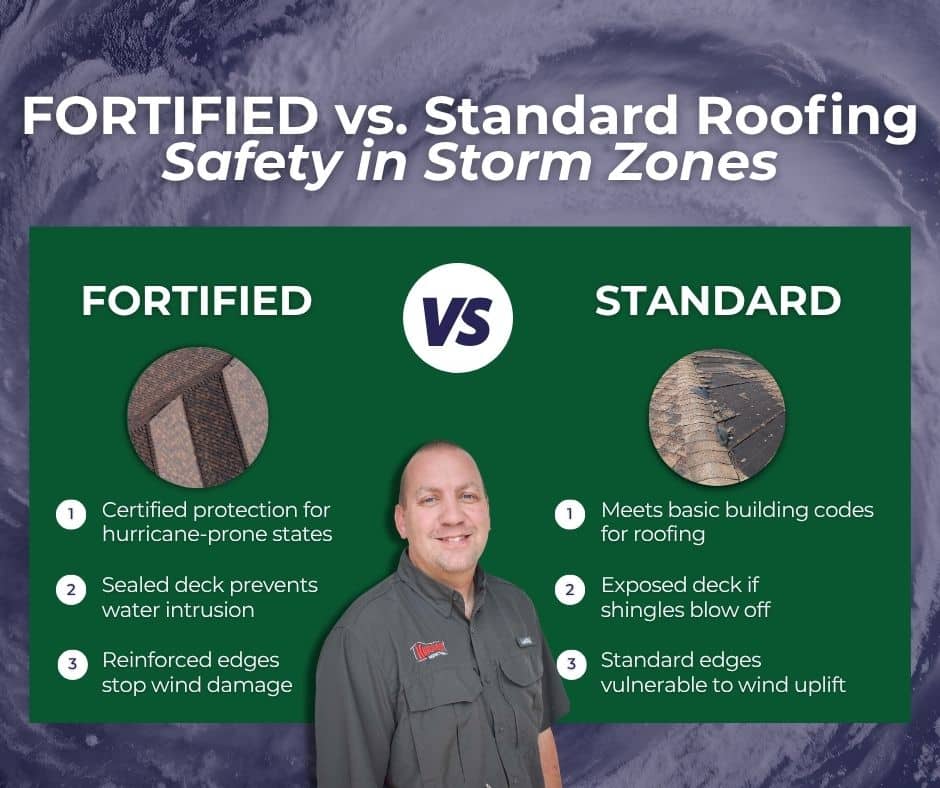
The most proven way to harden a roof is a FORTIFIED Roof, a standard developed by the Insurance Institute for Business & Home Safety to prevent the most common high-wind roof failures. A FORTIFIED Roof includes:
- Stronger ring-shank nails that keep the roof deck attached
- A sealed roof deck that blocks water if shingles blow off
- Reinforced edges so wind cannot peel layers back
- Stronger roof-to-wall connections that resist uplift
Homes built or re-roofed to the FORTIFIED standard are designed to take less damage in windstorms than homes built only to minimum code, according to IBHS research. If you want the technical side, here is how a FORTIFIED roof is built layer by layer.
A sealed roof deck also keeps water out long after the storm passes. Trapped moisture in walls and ceilings is one of the leading causes of mold that follows water intrusion, so a watertight deck does double duty.
Can You Upgrade an Existing Roof to FORTIFIED?
Yes. You do not have to wait for a full tear-off to strengthen your roof. A certified evaluator can assess your current roof and recommend steps like re-nailing the deck, sealing the seams, and upgrading edge materials. The most cost-effective time to go FORTIFIED is during a planned roof replacement, when the deck is already exposed. Knowing the parts that make up your roof makes it easier to follow what an evaluator is checking.
Don’t Overlook Windows, Doors, and the Garage
Even a strong roof can fail if wind gets inside the house, and the usual entry points are windows, doors, and the garage. Once a large opening fails, pressure builds inside and can push the roof off from below.
Here is what to check:
- Windows: Impact-rated glass or tested storm shutters stop flying debris from shattering the glass.
- Entry doors: Reinforce the frames, use heavy-duty hardware, and make sure the doors seal tightly.
- Garage doors: An unbraced garage door is often the first thing to go. A bracing kit or a wind-rated door keeps that large opening closed.
- Gable ends and vents: Brace tall gable-end walls and screen soffit vents, since wind-driven rain and pressure often enter there.
The garage door is the single biggest opening on most homes, which makes bracing it one of the highest-value upgrades for the money.
Consider a Safe Room or Storm Shelter
If you live in a high-risk area, a safe room gives you a place to ride out the worst of a storm even if the rest of the house is damaged. A safe room is a reinforced space, often a closet, bathroom, or interior room, anchored to the foundation and built to stay intact when everything around it does not. It works best within about 150 feet of where you sleep, and a closet or bathroom can double as one so the space is not wasted.
For real protection, build to a recognized standard. FEMA’s safe room guidance (standards FEMA P-361 and P-320) calls for walls, a roof, and a door that resist a 15-pound 2×4 fired at high speed and winds up to 250 mph. A safe room built to that level gives what FEMA calls near-absolute protection. Even a reinforced detached garage can be designed to serve the same purpose.
Costs vary widely by size and whether the room goes in a new or existing home, so treat any figure as an estimate until you get a local quote.
What Doesn’t Help: Tornado Myths to Skip
Plenty of storm advice gets passed around that does nothing or makes things worse. Skip these:
- Taping windows does not stop them from breaking. It just creates larger, more dangerous shards.
- Opening windows to “equalize pressure” is false and dangerous. It invites wind and debris straight in.
- “Tornado-proof” marketing claims with no FORTIFIED, FEMA, or ICC 500 certification behind them are just sales language.
Real protection comes from building science, tested materials, and certified work, not gimmicks. That is why the materials used in FORTIFIED upgrades are chosen for tested performance rather than marketing.
What It Costs and How Grants Can Help
Strengthening a home costs less than most people expect, especially when grants are involved. A FORTIFIED Roof adds only a modest amount over a standard roof when it is done at replacement time, and many homeowners see lower insurance premiums afterward.
The bigger news for our region: several states fund FORTIFIED upgrades directly. If you are in our service area, these programs can cover a large share of the cost of a FORTIFIED Roof retrofit:
- Strengthen Alabama Homes
- Louisiana Fortify Homes
- Strengthen Mississippi Homes
- Strengthen Kentucky Homes
Grant amounts and eligibility change often, so confirm the current details before you budget. Knockout is certified to perform the evaluations these programs require, which is the first step to qualifying.
Related Questions to Explore
Are concrete, brick, or ICF homes tornado-proof?
No home is fully tornado-proof, but reinforced concrete and insulated concrete form (ICF) homes are among the most tornado-resistant, because their walls stand up to both high winds and flying debris. Brick veneer over a wood frame is weaker than it looks, since the frame underneath is the real structure. For most existing homes, strengthening the roof and openings delivers more protection per dollar than rebuilding in concrete.
Can you make a mobile home tornado-proof?
You cannot make a mobile or manufactured home tornado proof, and they are among the most dangerous places to be during a tornado. The safest plan is to leave early and shelter in a FEMA-rated safe room or community shelter. Anchoring and tie-downs help in lower winds but will not protect against a strong tornado.
Are hurricane-resistant homes also tornado-resistant?
Largely yes. The same continuous load path, sealed roof deck, impact-rated openings, and strong connections that protect a home from hurricanes also help against tornadoes. That overlap is why the FORTIFIED standard works against both threats, which matters along the Gulf Coast where homes face hurricanes and tornadoes alike.
How much does it cost to make a house more tornado-resistant?
It depends on the upgrade. Bracing a garage door runs a few hundred dollars, a FORTIFIED Roof adds a moderate amount at replacement time, and a safe room is the largest single investment. State grant programs can offset much of the roof cost, so the real number depends on your home and your location.
Why isn’t any home completely tornado-proof?
Because an EF5 tornado produces winds over 200 mph and turns ordinary objects into flying missiles, no affordable home can be guaranteed to survive a direct hit untouched. The goal is to sharply lower the odds of catastrophic damage and to give your family a protected place to shelter, which tested upgrades reliably do.
When to Call a Professional
You do not have to sort this out alone. A certified inspector and FORTIFIED Evaluator can assess your home’s current storm readiness and tell you which upgrades give you the most protection for your budget.
Consider scheduling an evaluation if:
- Your roof is more than 10 years old or due for replacement
- You want to pursue a FORTIFIED designation or a state grant
- You are buying or selling and want to understand a home’s storm vulnerabilities
- You live anywhere along the Gulf Coast or in a tornado-prone region
Knockout Inspections is certified to perform FORTIFIED Home evaluations across Alabama, Florida, Louisiana, Mississippi, and Kentucky, with FORTIFIED evaluations available nationwide. A standard home inspection can also flag storm weak points before they turn into expensive problems.
Conclusion
No home is completely tornado-proof, but the right upgrades make a real difference:
- Start with the roof, then secure windows, doors, and the garage
- Add a FEMA-rated safe room for the highest level of protection
- Use FORTIFIED standards and state grants to do it affordably
The key is working with people who know which standards and upgrades actually hold up. Ready to see how your home measures up? Schedule a FORTIFIED evaluation with Knockout Inspections and protect what matters most.