
DOE also says assessors should hold “industry accepted credentials.” That line matters more than it looks, and the next section explains why.
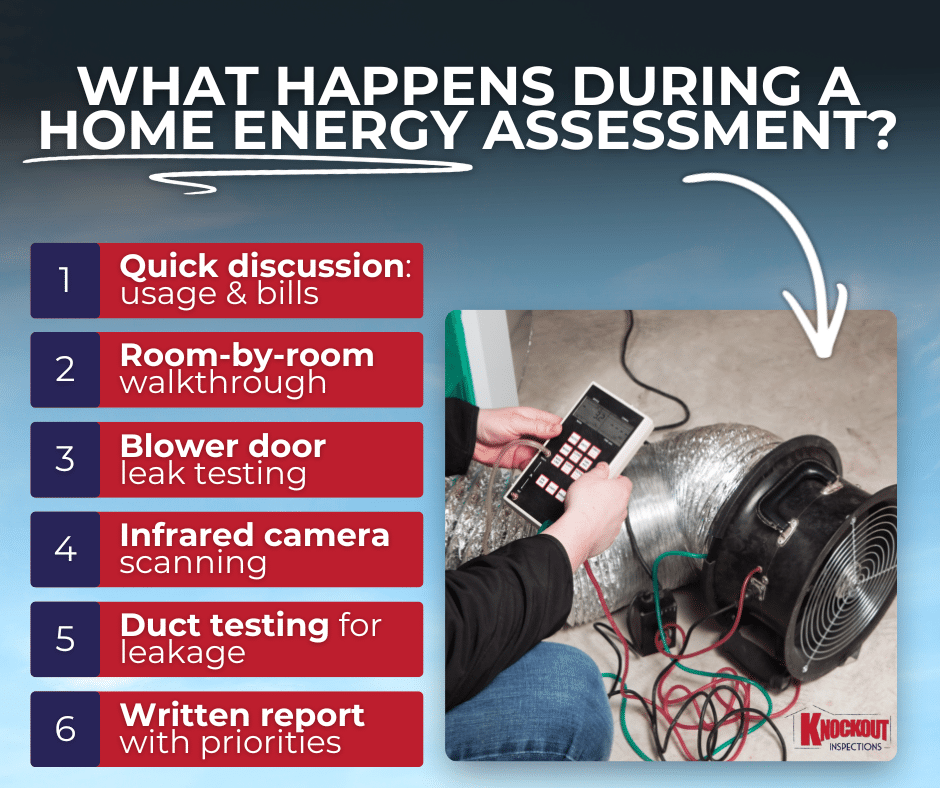
An assessor spends two to four hours testing your house, not looking at it. A blower door measures how much air leaks out, an infrared camera shows where insulation fails, and a room-by-room walkthrough catches the rest. You end up with a written report ranking fixes by what actually saves money.
That’s the short version. Here is what each part involves, how an assessment differs from the other energy services people confuse it with, and one thing about the federal tax credit that most articles still have wrong.
The Visit, Step by Step
Every assessor works a little differently, but the sequence is fairly standard.
1. A conversation about your bills: Which rooms never get comfortable, what your utility costs run, whether anyone has touched the insulation or ductwork. Homeowners usually know where the problem is; they just do not know why.
2. A room-by-room walkthrough: The U.S. Department of Energy describes this as a core part of a professional assessment. The assessor checks insulation levels, windows and doors, appliances, and the condition of the mechanical systems.
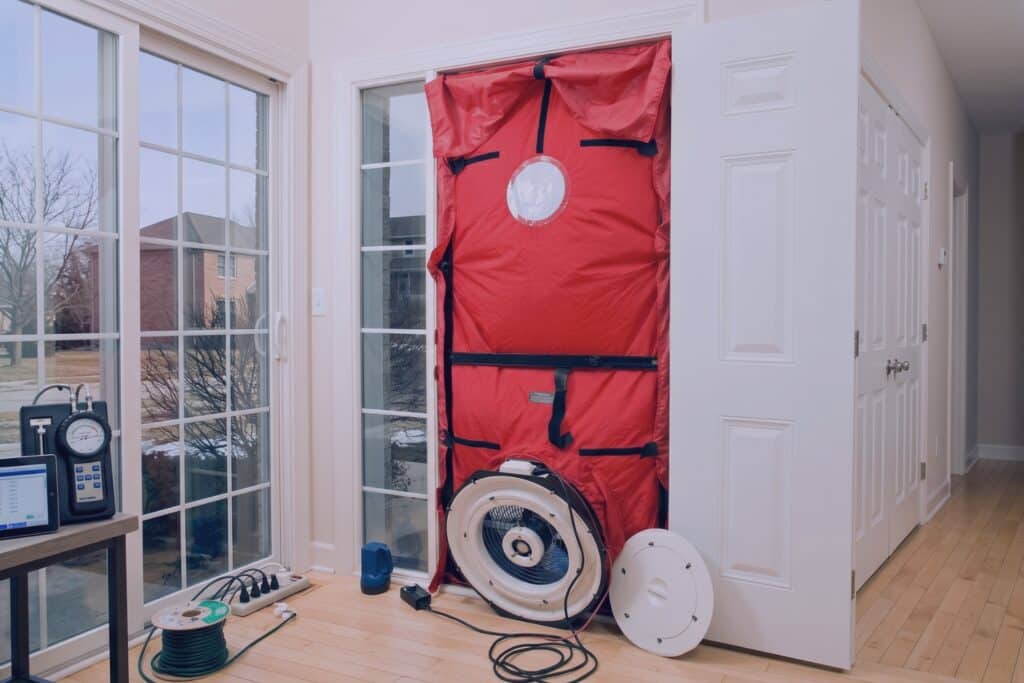
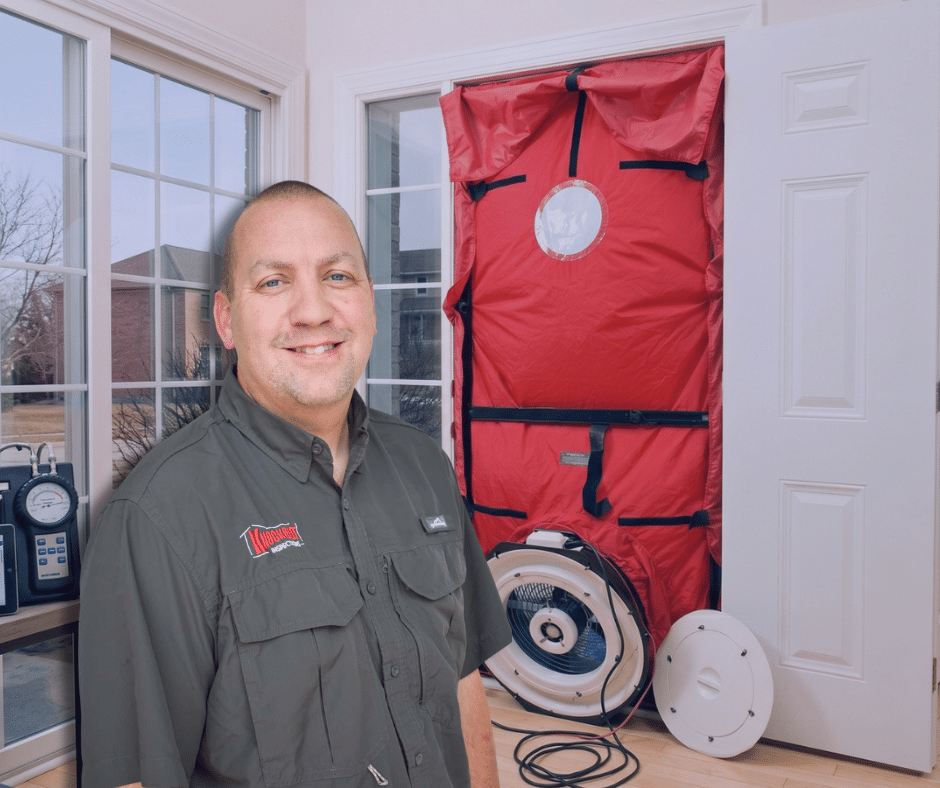
3. The blower door test: A calibrated fan mounted in an exterior doorway depressurizes the house so leaks can be measured and located. Interior doors get propped open, combustion appliances get shut down, and the fan pulls the house to a set pressure while a gauge records how hard it has to work. A leaky house needs a lot of fan. This is the single most informative thing that happens all day, because it converts a vague complaint into a number you can compare before and after.
4. A thermographic scan: An infrared camera reads surface temperatures, making missing insulation, thermal bridging, and air paths visible.
5. Duct testing: Pressurizing the duct system separately shows how much air is escaping before it ever reaches a room. In our practice, this is where the worst numbers usually show up, especially on homes with ducts running through a vented attic.
6. The report: A written document listing findings and prioritizing improvements by likely return. This is the deliverable you are actually paying for, and it is what separates a real assessment from a sales walkthrough. A good report tells you what to do first, what to skip, and what to leave alone.
The Tests That Do the Real Work
DOE notes that professional assessors use “blower doors, infrared cameras, gas leak and carbon monoxide detectors, moisture meters, and non-toxic smoke pens.” Three of those carry most of the weight:
- Blower door. Quantifies whole-house air leakage. Without it, everything else is opinion.
- Infrared camera. Turns invisible problems visible. Compressed batts, missing insulation over soffits, and gaps around can lights all show up as temperature anomalies.
- Duct leakage testing. Measures how much conditioned air never reaches a register. Our post on how blower door and duct tests affect energy costs goes deeper on the numbers.
Assessment, Audit, HERS, or Inspection?
These four get used interchangeably, and they are not the same thing. Nobody explains this well, so here it is plainly.
| Service | What it is | Who performs it |
|---|---|---|
| Home energy assessment | Diagnostic of an existing home, plus a written report of prioritized fixes | BPI Building Analyst |
| Home energy audit | The same thing. Different word. | BPI Building Analyst |
| HERS rating | A scored index of energy performance, modeled and tested | RESNET-certified HERS Rater |
| ENERGY STAR certification | Pass/fail verification against an EPA program checklist | ENERGY STAR credentialed rater |
| Home inspection | Condition and defect inspection for a real estate transaction | Licensed home inspector |
Two takeaways from that table.
“Assessment” and “audit” mean the same thing. If a company quotes you one and a competitor quotes the other, you are comparing the same service.
A home inspection is not an energy assessment. A standard inspection tells you whether things are broken. It does not measure how your house performs. Different tools, different credential, different report. Plenty of homeowners assume the inspection they got at closing covered this. It did not.
About That Federal Tax Credit
Most articles on this topic will tell you a home energy audit qualifies for a federal tax credit worth 30 percent of the cost up to $150. That expired.
The Energy Efficient Home Improvement Credit under Section 25C was terminated by Public Law 119-21, signed July 2025. Per the IRS, qualifying property had to be placed in service before December 31, 2025. There is no 25C credit for a 2026 assessment.
Worth knowing why you will keep seeing otherwise: ENERGY STAR’s own tax credit page still describes the audit credit as active, and a long list of contractor blogs and tax software articles have not updated either. If a company is using the credit to sell you an assessment in 2026, that is a reason to ask what else on their site is out of date.
Confirm your own situation with a tax professional. State and utility incentives are separate from the federal credit and may still apply.
What This Looks Like on the Gulf Coast
Most assessment content online comes from northern utilities, where the whole conversation is about heat loss in winter. Our region runs the other direction.
Down here the story is usually:
- Ducts in a hot, vented attic. Supply lines running through 130°F air, leaking conditioned air into a space you are not trying to cool.
- Humidity, not just temperature. Air leakage brings moisture with it, and moisture is what turns an efficiency problem into a mold problem.
- Cooling-dominated load. Sizing and duct design matter more here than insulation R-value arguments do, which is why load calculations are part of what we do.
If you are also weighing bigger-ticket decisions, our breakdown of which roof is more energy efficient covers where the roof does and does not move your bill.
Related Questions to Explore
How long does a home energy assessment take?
Typically two to four hours for a single-family home, depending on size, how accessible the attic and crawlspace are, and whether duct testing is included. The written report usually follows within a few days.
Is a home energy assessment worth it?
It is worth it when you plan to act on the findings. The value is not the visit; it is spending your improvement budget in the right order. Homeowners who get an assessment and then do nothing have bought a document.
What is the difference between an energy assessment and an energy audit?
Nothing. They are two names for the same service, and DOE and utility programs use both.
Do I need an energy assessment before insulating?
Not required, but recommended. Insulation is frequently the wrong first move. If your ducts are leaking badly or the house has major air leakage paths, adding insulation on top of those problems buys you less than fixing them first.
Can my home inspector do an energy assessment?
Only if they hold the separate credential. A home inspection license and a BPI certification are different qualifications with different training and different equipment.
When to Call a Professional
Three situations where an assessment earns its cost:
- Your bills do not match your house. High usage with no obvious explanation almost always traces to duct leakage or air sealing.
- You are about to spend real money. New HVAC, a reroof, or an insulation project. Test first, so the money goes where it does the most.
- Comfort problems you cannot solve. One room that never cools, humidity you cannot get down, a system that short-cycles.
Knockout Inspections runs blower door and air duct testing with Building Performance Institute certified staff across Alabama, Florida, Louisiana, Mississippi, and Kentucky. We also handle ENERGY STAR verification and Manual J load calculations for new construction.
Conclusion
- The tests are the point. A blower door and an infrared camera find what a walkthrough cannot. If nobody sets up a fan in your doorway, you did not get an assessment.
- Assessment and audit are the same thing. HERS ratings, ENERGY STAR certification, and home inspections are not.
- The federal audit tax credit ended after 2025. Most of the internet has not caught up.
Trying to figure out where your energy dollars are going? Schedule an energy evaluation with Knockout Inspections and get measurements instead of guesses.